
When Books Become a Bridge: Reading, Connection, and the Power of Being Seen
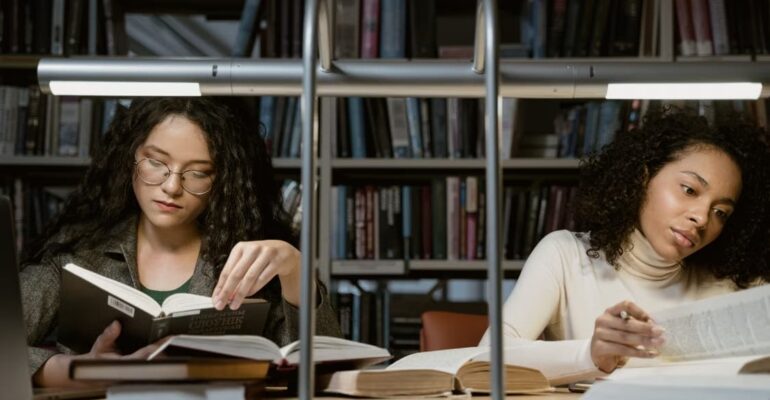
When Books Become a Bridge: Reading, Connection, and the Power of Being Seen
 S.Michele Echols
 A reflection for International Literacy Day inspired by Michelle Kuo’s Reading with Patrick
What can happen when two people sit down and read together?
At first, it might seem like a simple act.
A book is opened.
A few pages are read.
A conversation begins.
But sometimes reading becomes something more. It can create a space where people listen to one another, exchange ideas, discover different perspectives, and begin to see parts of themselves more clearly.
International Literacy Day offers an opportunity to think about literacy not simply as the ability to read and write, but as access to knowledge, expression, connection, and participation in the world around us.
This year, UNESCO marks the 60th International Literacy Day on September 8 under the theme “Literacy for people, the planet and prosperity.”
For Curated Collections, it also offers an opportunity to consider a quieter question:
What happens when a book becomes a bridge between people?
When Reading Becomes Shared
Michelle Kuo’s memoir, Reading with Patrick: A Teacher, a Student, and a Life-Changing Friendship, provides one deeply personal way into that question.
Kuo writes about her experience teaching English in Helena, Arkansas, and about her relationship with Patrick Browning, one of her former students.
Their story is shaped by much more than a classroom.
It touches education, race, poverty, incarceration, justice, friendship, and the possibilities—and limitations—of trying to help another person.
After Kuo leaves Arkansas to attend law school, she later learns that Patrick has been jailed. She returns to Helena and begins reading and writing with him while he awaits trial.
For months, they spend time with novels, poetry, and historical writing.
The reading becomes part of a much larger conversation about identity, imagination, education, and what it means to know another person.
Kuo’s own description of the memoir emphasizes the ways books can connect people and the questions raised when two people with very different circumstances try to understand one another.
More Than Learning to Read
Literacy is often discussed in terms of skills.
Can someone read?
Can someone write?
Can someone access information?
These questions matter.
But reading also has an interior dimension.
A person encounters a sentence and recognizes something of their own experience.
A poem introduces an unfamiliar way of seeing.
A memoir allows us to enter a life very different from our own.
A story gives us language for something we could not quite name.
This is part of what makes reading so personal.
The book remains the same, but the reader brings an entire life to it.
Reading Together
One of the questions raised by Reading with Patrick is particularly interesting from a bibliotherapeutic perspective:
How is reading alone different from reading together?
Penguin Random House’s reader’s guide for the memoir includes this question among its discussion prompts. It invites readers to think about their own experiences of being read to, reading to someone else, and sharing literature.
There is something worth pausing over here.
We often think of reading as an individual activity.
A quiet chair.
A book.
Time alone.
But books can also create relationships.
We recommend a passage to a friend.
We discuss a character with someone who read the same novel.
We give a book to a person because we think they might understand something within it.
We read a poem aloud.
We write about what a story made us feel.
In these moments, literature moves beyond the page.
It becomes part of a conversation.
The Importance of Being Seen
One of the most moving ideas to consider in Kuo’s memoir is not simply that books can educate, but that reading can create a space for someone’s inner life.
Kuo’s account describes Patrick’s growing engagement with literature and writing while also confronting the much larger circumstances surrounding his life.
The story does not suggest that books alone can erase poverty, inequality, racism, or failures within educational and criminal justice systems.
In fact, the memoir asks difficult questions about the limits of education and individual acts of help.
That complexity matters.
A bibliotherapeutic reading of the book does not require us to turn literature into a promise that reading will transform every circumstance.
Instead, it allows us to ask what happens when someone is given time, attention, language, and the opportunity to express what is inside them.
Sometimes being listened to can matter as much as being instructed.
What Readers Say
Reading with Patrick has received a strong response from Goodreads readers. The book currently holds an average rating of about 4.16 out of 5, based on more than 6,000 ratings and more than 1,000 reviews.
Many readers respond to the memoir’s treatment of friendship, literature, education, and the complicated circumstances surrounding Patrick’s life.
But the response is not simply a collection of uncomplicated praise.
Some readers have also questioned the teacher-student dynamic and the possibility of viewing one person’s help as a solution to much larger structural problems.
That range of response is important.
A thoughtful reading does not require us to agree with every aspect of a book.
Sometimes a book is valuable precisely because it leaves us wrestling with questions.
A Bibliotherapeutic Pause
When we approach a book through a bibliotherapeutic lens, we can ask what the reading experience brings up for us.
Reading with Patrick might prompt questions such as:
What books have helped me understand someone else’s experience?
Have I ever shared a book with someone and felt closer because of it?
What does it mean to truly listen to another person’s story?
Are there people whose experiences I have made assumptions about without taking the time to understand them?
And perhaps the simplest question:
What has reading helped me see that I might otherwise have missed?
There are no required answers.
The purpose is reflection.
Literacy as Connection
International Literacy Day reminds us that literacy is about more than individual achievement.
It is connected to access, opportunity, participation, and the ability to engage with the world.
But books also remind us of something deeply human.
Every reader brings a story with them.
Every person carries experiences that may not be immediately visible.
And sometimes a book gives us a way to cross that distance.
Reading with Patrick is ultimately much larger than a story about a teacher and student reading together.
It raises difficult questions about education, inequality, justice, friendship, and responsibility.
But it also brings us back to something wonderfully simple:
two people reading together can create a space for conversation.
Perhaps that is one of the quiet gifts of literacy.
Not only that we learn to understand words on a page, but that those words can help us understand one another.
A Reflection for International Literacy Day
This September, you might choose a book that takes you somewhere unfamiliar.
Read a memoir from a life different from your own.
Read a novel set in a place you have never visited.
Read an essay that challenges an assumption.
Or return to a book that once helped you see something differently.
Then pause.
Ask yourself:
What did this book help me notice?
Whose perspective did it bring closer?
What conversation might begin because of what I read?
Sometimes reading changes the way we understand a subject.
Sometimes it changes the questions we ask.
And sometimes, quietly, it helps us see another person—and ourselves—with a little more attention.
🌐 Website: curatedcollectionsbysme.com
📧 Email: michele@curatedcollectionsbysme.com
🔗 LinkedIn: smicheleechols
📌 Pinterest: Curated Collections by SME
Disclaimer
Bibliotherapy is not intended to substitute for professional advice, diagnosis, medical treatment, medication, or therapy. Always seek the advice of your physician or qualified mental health professional with questions regarding a mental health symptom or medical condition. Bibliotherapy should not be used to make recommendations about medication or as a substitute for professional care. Never disregard professional medical or psychological advice or delay seeking professional advice or treatment because of something you have read through bibliotherapy.

